Last updated: 21 October 2026
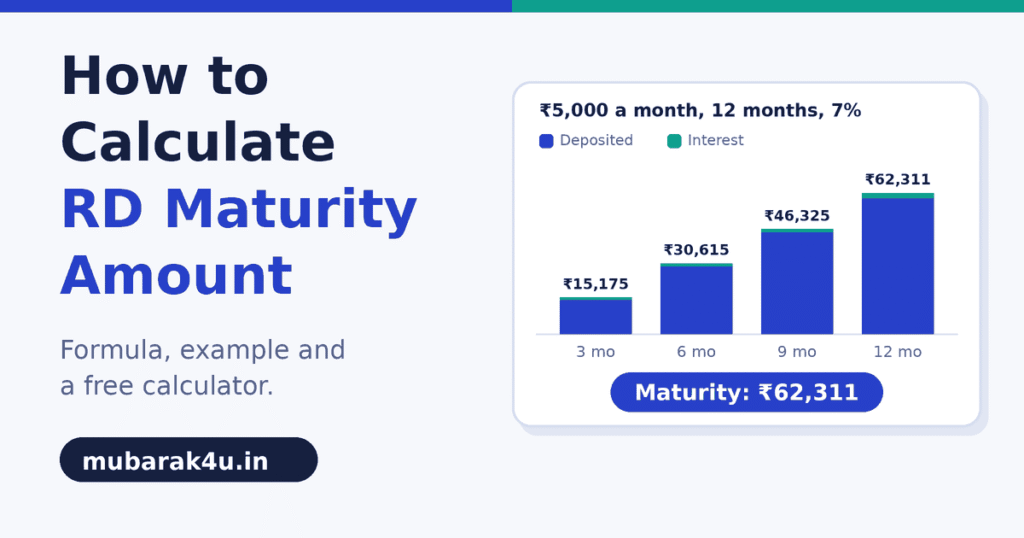
Here is how to calculate RD maturity amount: treat each monthly deposit as its own small investment, grow it for the months it stays in the account, and add them all up. For ₹5,000 a month over 12 months at 7%, that comes to about ₹62,311. You deposit ₹60,000 and earn about ₹2,311.
Doing that by hand takes a while, so the RD calculator does it for you. This guide explains what it does, why the interest looks small, and how tax affects it.
How to calculate RD maturity amount: the formula
Many Indian banks add RD interest every quarter, and the calculator does the same. Here is the method:
- Find the quarterly rate: annual rate ÷ 400. At 7% that’s 1.75% a quarter, or 0.0175.
- Take one monthly deposit. A deposit that stays for n months grows by (1 + quarterly rate) raised to the power n ÷ 3.
- Do that for every deposit. The first deposit stays the longest, and the last one stays for one month.
- Add the grown amounts. That total is the maturity amount.
Try it with ₹5,000 for 12 months at 7%. The first deposit stays 12 months: 5,000 × 1.0175 to the power 4, which is ₹5,359.30. The last deposit stays one month: 5,000 × 1.0175 to the power one-third, which is ₹5,029.00. The 10 deposits in between fall between those two numbers. Together they add up to ₹62,310.66, which the calculator rounds to ₹62,311.
The same example, quarter by quarter
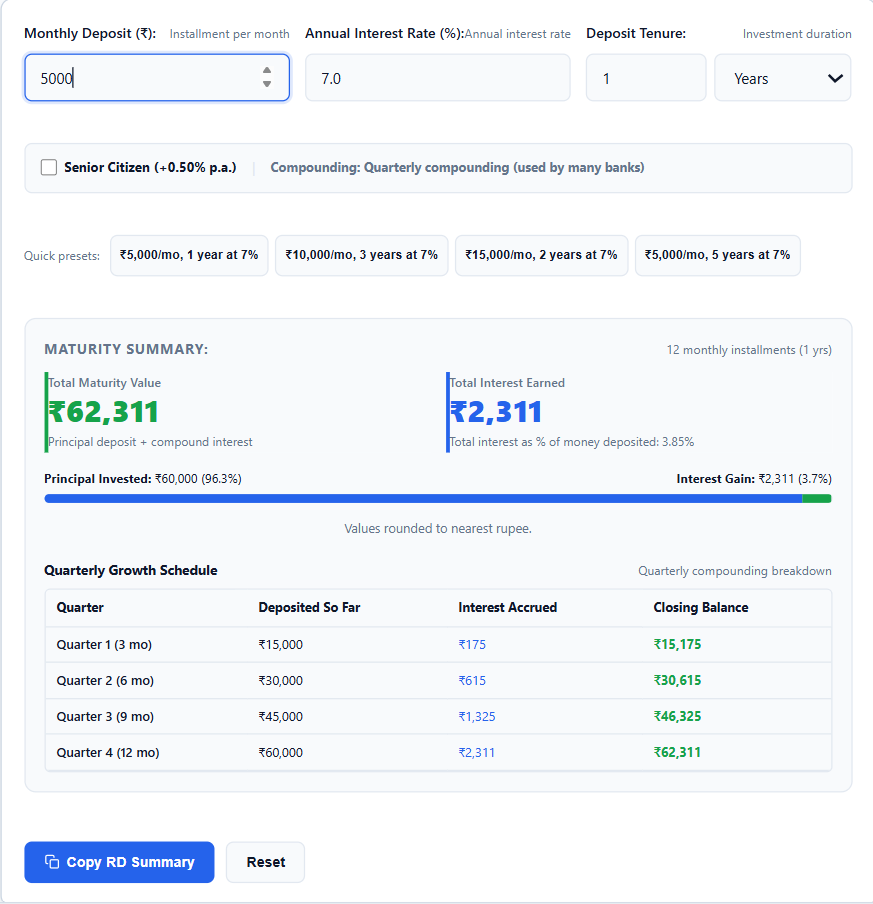
The calculator’s schedule shows the first year like this:
- After 3 months: ₹15,000 put in, interest ₹175, balance ₹15,175
- After 6 months: ₹30,000 put in, interest ₹615, balance ₹30,615
- After 9 months: ₹45,000 put in, interest ₹1,325, balance ₹46,325
- After 12 months: ₹60,000 put in, interest ₹2,311, balance ₹62,311
The interest column adds up as you go. It shows all the interest earned so far, not just that quarter’s.
Using the RD calculator, step by step
- Open the RD calculator.
- Type your monthly deposit.
- Type the annual interest rate your bank quotes.
- Choose the tenure in years or in months, and type a whole number.
- Tick the Senior Citizen box only if you want the calculator to add 0.50 percentage points to your rate.
- Read the maturity amount, the interest earned and the bar that splits your deposit from your interest.
- Open the quarterly schedule to see how the balance grows.
- Click Copy RD Summary to keep the numbers.
The quick buttons fill in examples like ₹5,000 a month for one year at 7%. They’re just examples, not a bank’s rate.
Why the interest looks small
The calculator shows total interest as a percentage of the money you deposited. For the ₹5,000 example that’s 3.85%. People often read this as the interest rate, but the rate was 7%.
The gap exists because your money goes in slowly. The first ₹5,000 earns for 12 months. The last ₹5,000 earns for one month. On average, your money works for about half a year.
Compare it with putting the same ₹60,000 into a one-year deposit on day one, with interest added every quarter at 7%. It grows to ₹64,311.54, so the interest is ₹4,311.54, almost twice the RD’s ₹2,310.66. You can test this with the compound interest calculator. That’s no reason to pick one over the other, because most people choose an RD when they can’t put in ₹60,000 at once.
A longer example
Say you save ₹10,000 a month for 36 months at 7%. You put in ₹3,60,000. The maturity amount is about ₹4,01,373, and the interest is about ₹41,373. That’s 11.49% of what you deposited.
Longer tenures give a higher percentage because compounding has more time to work.
The Senior Citizen box
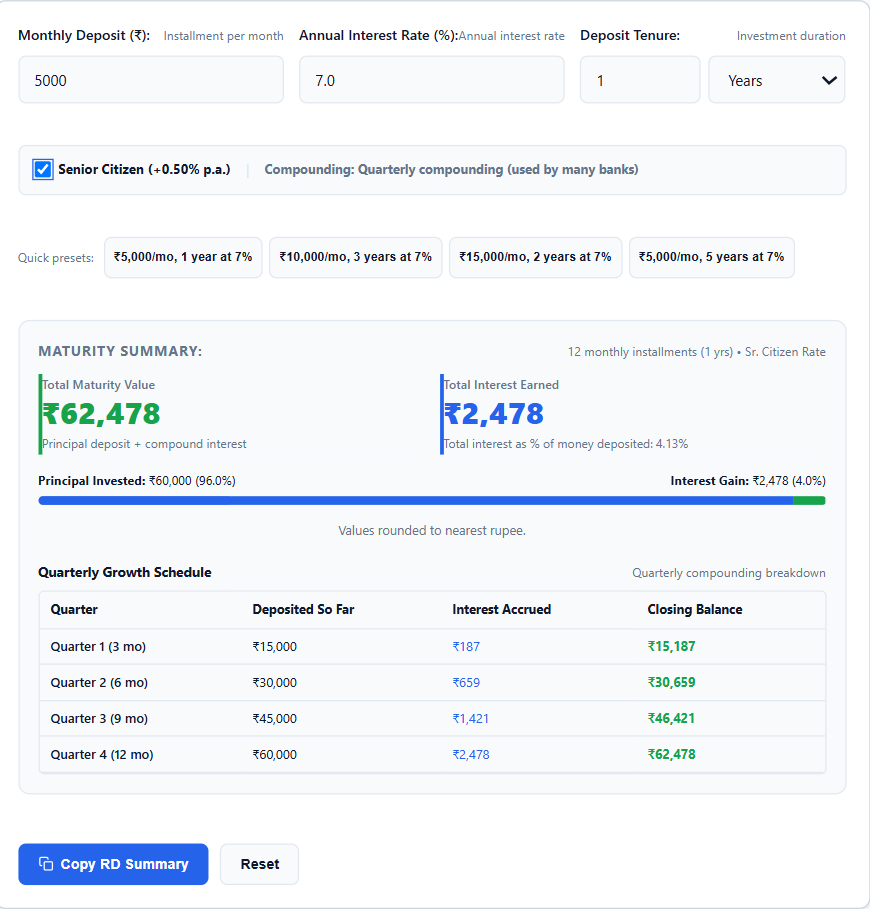
The box adds 0.50 percentage points to the rate you type. If you type 7 and tick it, the calculator uses 7.5%. For the ₹5,000, 12-month example, the maturity goes from ₹62,311 to about ₹62,478, which is about ₹167 more.
Banks give seniors different extra amounts. If your bank quotes a rate for seniors, type that rate in and leave the box unticked. Otherwise you add the extra twice.
Check the result against your bank
Open your bank’s own RD calculator or your passbook and enter the same deposit, rate and tenure. A difference of a few rupees is common, because banks can count days and round in their own way.
A big difference points to a different rate, a different tenure or a late installment.
Tax on RD interest
RD interest counts as your income, whether or not the bank deducts tax.
A bank deducts 10% TDS (20% if you haven’t given your PAN) when the interest it pays or credits you in a financial year goes above ₹50,000, or ₹1,00,000 if you’re a senior citizen. Banks that use core banking count all your FDs and RDs with that bank together, whichever branch they sit in.
Say you earn ₹60,000 of interest at one bank. The bank deducts ₹6,000, which is 10% of the whole ₹60,000, not only of the part above ₹50,000.
If your total income is below the taxable limit, you can give your bank a declaration (Form 15G, or Form 15H if you’re 60 or older) so it doesn’t deduct TDS. Form numbers may change under the Income-tax Act, 2025, so ask your bank which form it accepts.
TDS is not the full tax. You report the interest in your return and pay tax at your slab rate.
Since 1 April 2026, this rule sits in Section 393(1) of the Income-tax Act, 2025. Before that it was Section 194A. Rules change, so check the Income Tax Department website for the current figures.
What the calculator can’t tell you
- Your bank’s method can differ slightly, so the maturity amount is an estimate.
- It doesn’t include any penalty for a late installment. Ask your bank.
- It doesn’t include tax.
- Rates change. The calculator uses the rate you type, and nothing else.
Mistakes to avoid
- Reading the “interest as a percentage of the deposit” as the interest rate
- Typing years in the box when you meant months, or the other way round
- Ticking the Senior Citizen box and also typing a senior rate
- Comparing an RD with a one-time deposit and forgetting the money goes in over time
- Assuming no TDS means no tax. Interest is still your income.
Quick answers
How much will I get on ₹5,000 a month for 1 year at 7%?
About ₹62,311. You deposit ₹60,000 and earn about ₹2,311.
Is RD interest compounded quarterly?
Many banks do it that way, and the calculator does too. Check your bank’s terms, because the method can differ.
Is there TDS on RD interest?
Yes, if the interest your bank pays or credits you in a year goes above ₹50,000, or ₹1,00,000 for senior citizens. Check the Income Tax Department website for the current rules.
To try your own numbers, open the RD calculator.
Author: Kailash Choudhary
Kailash Choudhary runs Mubarak4u.in from Makrana, Rajasthan. He writes practical guides for the site.