Last updated: 22 October 2026
Your bike’s company claims 60 km/L. Your friend’s same model gives him 55. Yours gives 42. Which number is right?
Only a tank-to-tank reading tells you your real mileage. A mileage and fuel cost calculator then turns it into a cost per kilometre and a trip bill. At ₹100 a litre (an example price), 42 km/L costs ₹2.38 per kilometre, while 60 km/L costs ₹1.67.
How to calculate mileage: the tank-to-tank method
This method needs two visits to a fuel station and no app.
Step 1: Fill to the cut-off. Fill the tank until the nozzle clicks off by itself. Don’t top up after the click. Reset the trip meter to zero, or note the odometer reading.
Step 2: Drive normally. Use the vehicle the way you always do: city traffic, highway, AC if you use it. Drive until the tank is about a quarter full. Aim for at least 200 to 300 km, because a longer distance gives a steadier result.
Step 3: Fill to the cut-off again. Go back to the same pump if you can, and fill until the nozzle clicks off. Note the litres that went in, and the kilometres on the trip meter.
Step 4: Divide. Mileage = kilometres travelled ÷ litres filled.
Say you rode 300 km and the second fill took 20 litres. That’s 300 ÷ 20 = 15 km/L. This is your real-world mileage.
Why the trip computer and the pump can differ
The trip computer shows an estimate, and the number can differ from what the pump delivers. I think it’s worth checking it against one tank-to-tank reading.
The pump figure is the fuel you paid for. Use it for budgeting, and to check whether your mileage has dropped, which can be a sign that the vehicle needs a service.
Use more than one fill-up
A single reading can be off, because the pump cut-off isn’t always exact. Do two or three fill-ups to get a steady number.
Don’t average the km/L figures. Add up all the kilometres, add up all the litres, and divide the totals.
Say fill-up 1 was 300 km on 20 litres (15 km/L) and fill-up 2 was 200 km on 10 litres (20 km/L). The average of 15 and 20 is 17.5, which is wrong. The right figure is 500 ÷ 30 = 16.67 km/L, because the first trip used more fuel.
From mileage to money: cost per kilometre
Cost per km = fuel price per litre ÷ mileage.
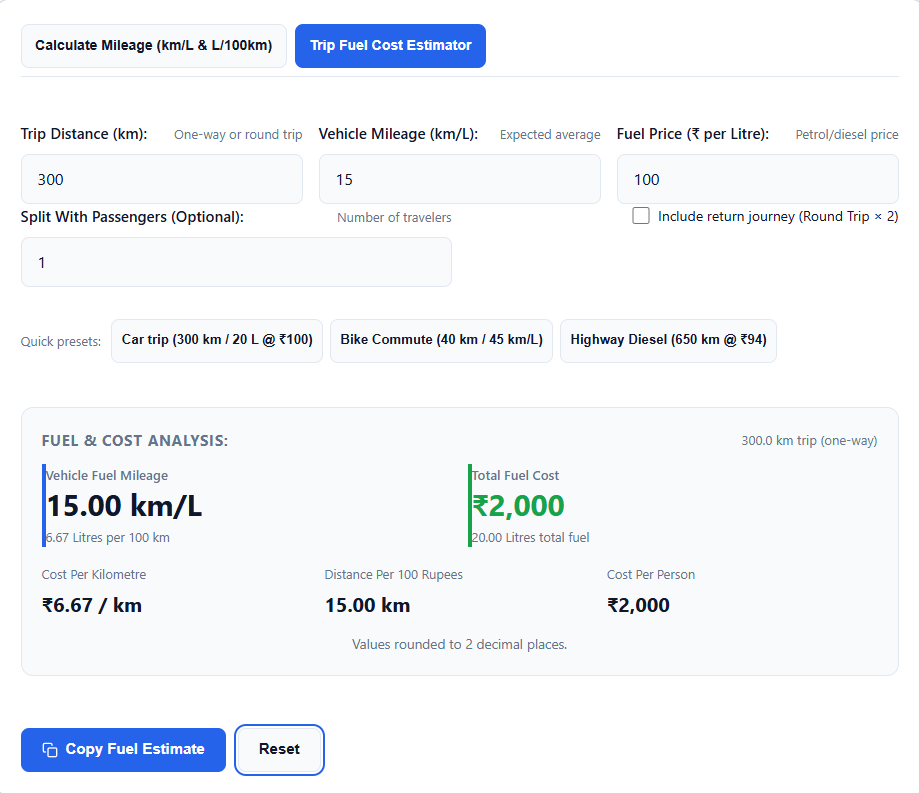
Say petrol is ₹100 a litre and your car gives 15 km/L. That’s 100 ÷ 15 = ₹6.67 per km. A 300 km weekend trip costs about ₹2,000 in fuel.
At the same ₹100 a litre:
- 10 km/L costs ₹10.00 per km
- 15 km/L costs ₹6.67 per km
- 20 km/L costs ₹5.00 per km
- 42 km/L costs ₹2.38 per km
- 60 km/L costs ₹1.67 per km
The mileage and fuel cost calculator does this for you. Enter the distance, the fuel used and the pump price, and it shows km/L, litres per 100 km, the total cost and the cost per km.
What a lower mileage costs you
Take the bike from the start. Say you ride 1,000 km a month with petrol at ₹100 a litre.
- At 60 km/L, you use 16.67 litres and pay ₹1,667
- At 42 km/L, you use 23.81 litres and pay ₹2,381
That’s ₹714 more every month, about ₹8,500 a year. A mileage that drops from your usual figure is often a sign of low tyre pressure, a dirty air filter or a service that’s due. Check those first.
Price a planned trip before you leave
Reverse the formula:
- Fuel needed = trip distance ÷ your mileage
- Trip cost = fuel needed × fuel price
Delhi to Jaipur is roughly 280 km one way, depending on the route. Your car gives 15 km/L and petrol is ₹100 a litre. The fuel needed is 280 ÷ 15 = 18.67 litres, and the cost is about ₹1,867 one way, or about ₹3,733 for the return.
The calculator’s trip tab does this. Enter the distance, your mileage and the price, tick the return journey box, and it doubles the distance for you. This counts only fuel, so add tolls and parking separately.
Splitting fuel costs between friends
A simple way is to split the fuel cost equally between everyone in the car, including the driver. Some groups give the driver a smaller share because the driver also supplies the car. Agree on the rule before you leave.
Take 4 friends on a 600 km round trip, with a car that gives 15 km/L and petrol at ₹100 a litre. The total fuel is 600 ÷ 15 = 40 litres, which costs ₹4,000. That’s ₹1,000 each.
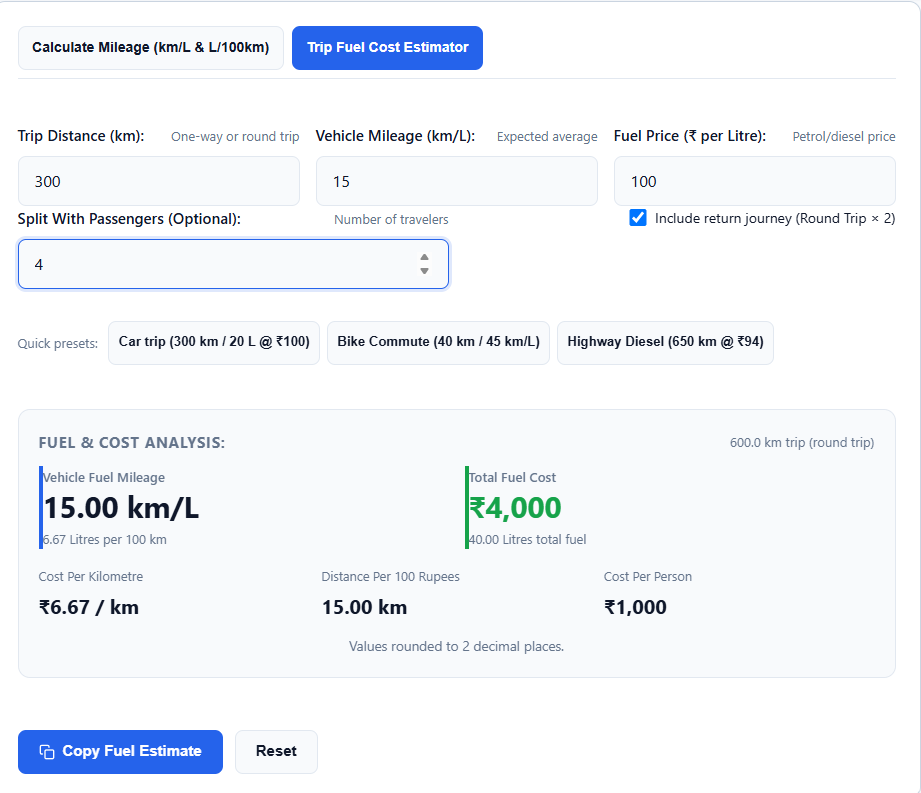
The trip tab has a passenger count field that does the split, and a copy button to paste the breakdown into WhatsApp.
km/L vs litres per 100 km
In India we say “my car gives 15 km/L.” Many other countries rate the same car at 6.67 L/100 km. They’re two ways of saying the same thing:
L/100 km = 100 ÷ km/L
With km/L, a higher number is better. With L/100 km, a lower number is better. The calculator shows both, so you can compare with any spec sheet.
5 habits that improve mileage
- Keep the tyres at the right pressure. Under-inflated tyres are a common cause of lower mileage. Check them every month when they’re cold. The correct pressure is usually on a sticker inside the driver’s door or in the manual.
- Drive smoothly. Hard acceleration and sudden braking can use noticeably more fuel. Accelerate gently and look ahead for stops.
- Cut idling. If you’ll be stopped for about a minute or more, switch the engine off. An idling engine gives you 0 km/L.
- Remove load you don’t need. A roof carrier or 50 kg of junk in the boot costs fuel on every trip.
- Service on time. A clogged air filter or old engine oil makes the engine work harder for the same output.
Measure your mileage, change one habit, and measure again after a month.
Why your real mileage won’t match one number
Your mileage changes with where and how you drive, and the calculator uses a single figure. Measure city and highway separately if your trips mix both.
Say you get 12 km/L in the city and 18 km/L on the highway. On a 300 km trip with 100 km in the city and 200 km on the highway, you use 100 ÷ 12 + 200 ÷ 18 = 8.33 + 11.11 = 19.44 litres. That’s 300 ÷ 19.44 = about 15.4 km/L overall, and about ₹1,944 in fuel at ₹100 a litre (an example price).
The calculator has no separate option for CNG, and its fields are labelled in litres. For a CNG vehicle, type the kilograms used in the litres box and the price per kilogram in the price box. Then read the result as km per kg. Treat every result as an estimate.
Frequently asked questions
Why is my real mileage lower than the company’s claim?
Company figures such as ARAI ratings are measured in lab conditions. Real roads, traffic, load and the way you drive usually give a lower number. Measure your own with the tank-to-tank method.
Does AC really reduce mileage?
Yes. Using the AC can lower mileage, more so in stop-and-go city traffic than at a steady speed on the highway.
How often should I check my mileage?
Once every two or three months is enough. A sudden drop, such as 15 km/L to 11 km/L, is an early warning. Get the vehicle checked before a small issue becomes an expensive repair.
Can I use the calculator for CNG or diesel vehicles?
Diesel works as it is, because it’s sold per litre. The calculator has no separate CNG option, so type the kilograms in the litres box and the price per kilogram in the price box, then read the result as km per kg.
Author: Kailash Choudhary
Kailash Choudhary runs Mubarak4u.in from Makrana, Rajasthan. He writes practical guides for the site, uses AI tools to help with drafts, and checks the figures before they go live.