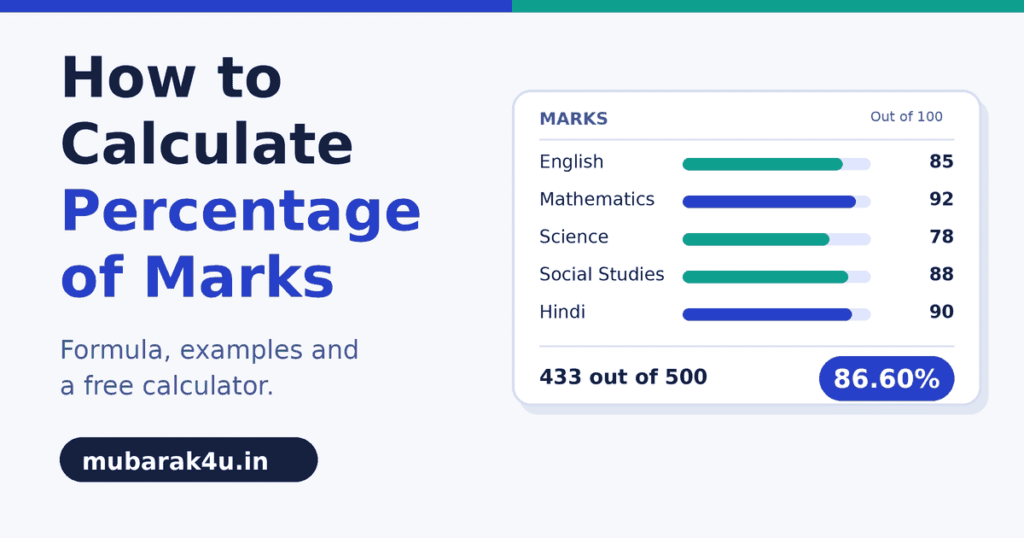
Here is how to calculate percentage of marks: add up the marks you got, divide by the total marks and multiply by 100. If you got 433 out of 500, that’s 433 ÷ 500 × 100 = 86.60 percent.
It sounds simple, but a few things trip people up. Subjects can have different total marks, a form may ask for your best five subjects only, and a good overall percentage can still hide one failed subject. This guide covers each case with worked examples. Use the marks percentage calculator to check your own numbers.
Last updated: 17 November 2026
How to calculate percentage of marks: the formula
Percentage = marks you got ÷ total marks × 100
Take five subjects, each out of 100:
- English: 85
- Mathematics: 92
- Science: 78
- Social Studies: 88
- Hindi: 90
The marks you got add up to 433 and the total marks are 500, so 433 ÷ 500 = 0.866, and 0.866 × 100 = 86.60 percent.
A quick shortcut when the total is a round number
When the total marks are a round multiple of 100, you can skip the multiplication and divide the marks by the number of hundreds. For a total of 500, divide by 5, so 433 ÷ 5 = 86.6.
| Total marks | Divide your marks by | Example |
|---|---|---|
| 200 | 2 | 156 ÷ 2 = 78% |
| 400 | 4 | 332 ÷ 4 = 83% |
| 500 | 5 | 433 ÷ 5 = 86.6% |
| 600 | 6 | 479 ÷ 6 = 79.83% |
| 800 | 8 | 640 ÷ 8 = 80% |
When subjects have different total marks
This is where most mistakes happen. Say you have five subjects, and one of them, a practical, is out of 50:
- Subject 1: 45 out of 50 (90%)
- Subject 2: 60 out of 100 (60%)
- Subject 3: 70 out of 100 (70%)
- Subject 4: 80 out of 100 (80%)
- Subject 5: 90 out of 100 (90%)
The easy way is to average the five percentages: (90 + 60 + 70 + 80 + 90) ÷ 5 = 78 percent, and that’s wrong. The right way is to add the marks you got (345) and the total marks (450), then divide: 345 ÷ 450 × 100 = 76.67 percent. A subject with more marks should count for more, and the 50-mark subject is worth half of a 100-mark one, so it cannot weigh the same as the others in the average.
Best five subjects or all subjects
Some forms count all your subjects and some count only the best five, and the form or the college decides which one applies. Here is an example with six subjects: 78, 85, 90, 66, 72 and 88, each out of 100. For all six, 479 ÷ 600 × 100 = 79.83 percent. For the best five, leave out the 66 and calculate 413 ÷ 500 × 100 = 82.60 percent. Colleges often state their own rule in the admission notice, such as the best four or best five subjects, with or without a compulsory language, so read it before you work out the figure to enter.
How many marks you need in the last subject
You can work backwards from a target. Say you want 75 percent overall and you have finished four subjects with 300 marks out of 400, and the fifth subject is out of 100. Multiply the target by the total marks: 75 percent of 500 is 375. Subtract the marks you already have, 375 minus 300, and you need 75 in the last subject. The general formula is marks needed = target percentage × total marks ÷ 100.
Marks needed for a target percentage
| Target percentage | Out of 500 | Out of 600 |
|---|---|---|
| 33% | 165 | 198 |
| 40% | 200 | 240 |
| 50% | 250 | 300 |
| 60% | 300 | 360 |
| 75% | 375 | 450 |
| 90% | 450 | 540 |
Passing marks and the CBSE rules
An overall percentage does not say whether you passed each subject. Under the CBSE rules, a Class 10 student needs 33% in each subject on the theory and internal marks combined, while a Class 12 student needs 33% in theory and 33% in practical separately. In a Class 12 science subject with 70 theory marks and 30 practical marks, the pass marks are 23 and 10, so 50 in theory and 8 in practical adds up to 58 percent but still fails the subject, because the practical is below 10. CBSE does not award a division, a distinction or an aggregate percentage on the marksheet, so the percentage a form asks for is calculated by you or by the institution. Other boards and universities use their own pass marks, such as 33%, 35% or 40%, and their own division names, so check your board’s notice, because rules can change from year to year.
A good overall percentage can hide a failed subject. Take 90, 90, 90, 90 and 30 out of 100, with a pass mark of 33%. The overall percentage is 390 ÷ 500 × 100 = 78.00, which looks great, but the last subject is below the pass mark, so the result is not a clean pass.
Rounding
A calculator shows two decimal places, and your marksheet or form may round differently. If 86.60 is on your screen and the form has space for a whole number, don’t round it yourself. Read the form’s instruction, because some want the exact figure and some want it rounded.
Percentage and CGPA are different
A CGPA is a grade point average and not a percentage. If your marksheet shows a CGPA, CBSE’s indicative formula is CGPA × 9.5, so a CGPA of 8.4 is about 79.8 percent. Use the CGPA to percentage calculator for that, and keep this method for marks.
Mistakes to avoid
- Averaging the subject percentages when the total marks are different
- Counting a subject the form doesn’t ask for
- Mixing up the total marks, for example typing 100 for a subject that is out of 50
- Entering practical and theory marks as two separate rows when the form treats them as one subject
- Rounding up on your own
Frequently asked questions
How do I calculate the percentage of 5 subjects?
Add the marks you got in all five subjects, divide by the total marks (500 if each is out of 100) and multiply by 100. For 433 out of 500 the answer is 86.60 percent.
How do I calculate percentage when total marks are different?
Add all the marks you got and all the total marks, divide the first by the second and multiply by 100. Don’t average the subject percentages.
How do I find the best five subjects percentage?
Drop the subject with your lowest marks so that five subjects are left, add those five scores, divide by the five totals and multiply by 100. If the form needs a compulsory subject, keep it in and drop the lowest of the others.
Does CBSE give an overall percentage?
No. CBSE does not give an aggregate percentage, division or distinction on the marksheet. Colleges and forms work it out from your subject marks, using their own rule for which subjects to count.
Is 33 percent the passing mark in every board?
Not in every one. CBSE uses 33% per subject, but several boards and universities use 33%, 35% or 40%, and some check theory and practical marks separately, so read your own board’s notice.
Does the calculator handle practical marks?
Add the theory and practical marks of a subject together, enter that as the marks you got, and enter the combined total as the total marks. The calculator uses one passing mark for all subjects, so if your board needs a separate pass mark for the practical, check that yourself.
To try your own marks, open the marks percentage calculator.
About the author
Kailash Choudhary writes education and tech guides for WorldInfoExpress and checks each article against official sources.
Last updated: 17 November 2026