Last updated: 24 October 2026
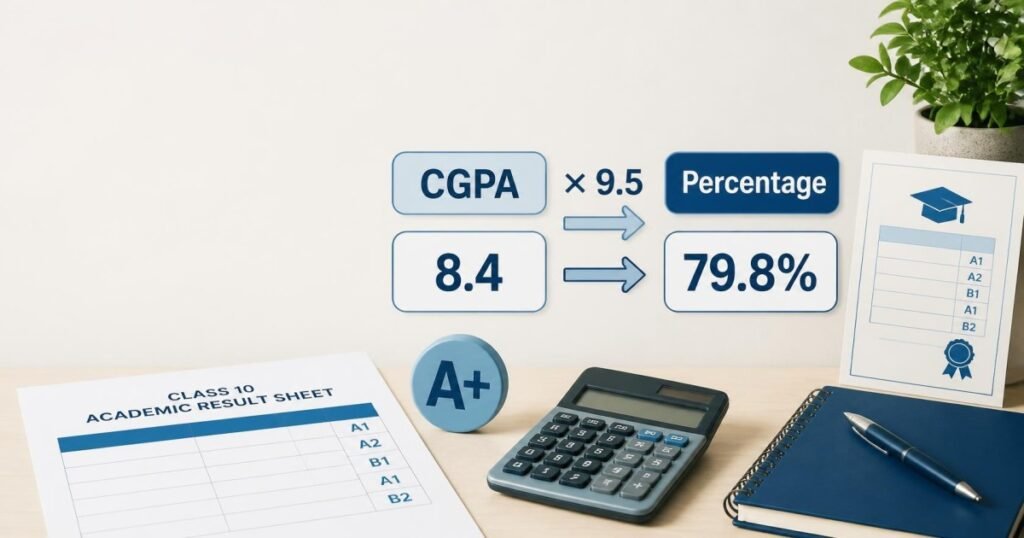
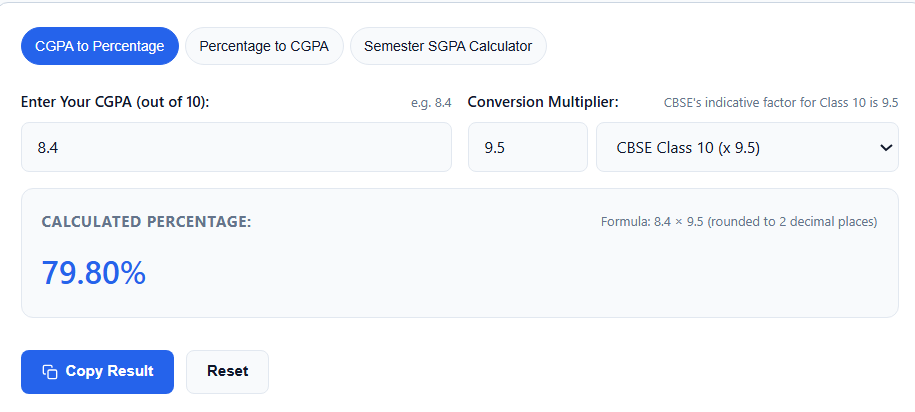
A form asks for your percentage, but your Class 10 marksheet shows a CGPA. The CBSE formula for CGPA to percentage is CGPA × 9.5, so a CGPA of 8.4 gives 8.4 × 9.5 = 79.8%. CBSE calls the result an indicative percentage, which means it is an equivalent figure and not your exact marks. If you only need the number, use the CGPA to percentage calculator.
CGPA to percentage CBSE formula: what the circular says
CBSE gave the rule in Circular No. 24, dated 28 May 2010, which covered admission to Class XI after grading started at the secondary level. The circular gives two formulas, and both describe the result as indicative.
- Overall indicative percentage = 9.5 × CGPA
- Subject-wise indicative percentage = 9.5 × grade point of the subject
The CGPA excludes the additional sixth subject. This 9.5 formula belongs to CBSE’s Class 10 grading system, so if your marksheet already shows marks, calculate the percentage from the marks.
How to convert CGPA to percentage
- Find your overall CGPA on the Statement of Subject-wise Performance.
- Multiply it by 9.5.
- Round the answer at the end, not before.
- If the form allows it, write the result as an approximate percentage.
A CGPA of 9.2 gives 9.2 × 9.5 = 87.4 percent, and a CGPA of 7.4 gives 7.4 × 9.5 = 70.3 percent. The highest CGPA is 10, and 10 × 9.5 = 95, so this formula never gives more than 95 percent, even for a student who scored full marks.
CGPA to percentage chart for CBSE
| CGPA | Indicative percentage |
|---|---|
| 6.0 | 57 |
| 6.5 | 61.75 |
| 7.0 | 66.5 |
| 7.5 | 71.25 |
| 8.0 | 76 |
| 8.5 | 80.75 |
| 9.0 | 85.5 |
| 9.5 | 90.25 |
| 10.0 | 95 |
How to find your CGPA from grades
If you only remember your grades, CBSE used a nine-point scale, which you can see in its performance profile format. Add the grade points of your five main subjects and divide by 5.
- 91 to 100 marks: A1, grade point 10
- 81 to 90 marks: A2, grade point 9
- 71 to 80 marks: B1, grade point 8
- 61 to 70 marks: B2, grade point 7
- 51 to 60 marks: C1, grade point 6
- 41 to 50 marks: C2, grade point 5
- 33 to 40 marks: D, grade point 4
- 21 to 32 marks: E1, no grade point
- 20 marks and below: E2, no grade point
Take five subjects: English A1 (10 points), Hindi A2 (9), Maths B1 (8), Science A2 (9) and Social science B2 (7). The total is 43, and 43 ÷ 5 = 8.6, so the CGPA is 8.6 and the indicative percentage is 8.6 × 9.5 = 81.7. You can also convert one subject at a time: Maths has grade point 8, so 8 × 9.5 = 76 percent, and Science has 9, so 9 × 9.5 = 85.5 percent.
How to convert percentage to CGPA
Divide the percentage by 9.5. For 80 percent, 80 ÷ 9.5 = 8.42, so the CGPA is about 8.42. The circular gives only the CGPA to percentage direction, and dividing is the same rule turned around, so treat the result as an estimate too.
Why the CBSE formula is only an estimate
A grade covers a band of ten marks, so everyone from 91 to 100 gets grade point 10, and the formula turns that into 95 percent for all of them. That leaves gaps between the formula and the real marks.
- A student with 91 in every subject gets CGPA 10, so the formula says 95 percent. The real percentage is 91.
- A student with 100 in every subject also gets 95 percent. The real percentage is 100.
- A student with 81 in every subject gets grade point 9, so the formula says 85.5 percent. The real figure is 81.
- A student with 90 in every subject gets the same 85.5 percent. The real figure is 90.
The formula can add or remove several points, so use it when a form asks for an equivalent percentage, and don’t use it to claim your exact marks. The lowest passing grade shows the same thing: grade D has grade point 4 and 4 × 9.5 = 38 percent, but D covers marks from 33 to 40.
If your result shows marks, not CGPA
CBSE went back to marks for Class 10 from the 2017-18 session, and Class 12 results have always been declared in marks, so a marksheet that shows marks needs no conversion. Use this instead: percentage = marks obtained ÷ maximum marks × 100. For example, 438 out of 500 is 438 ÷ 500 × 100 = 87.6 percent. Check the admission rules for the subjects the form counts, because some ask for all five main subjects and some for the best five, and the marks percentage calculator adds the subjects for you.
University CGPA is different
The 9.5 rule applies to the CBSE Class 10 grading system, and universities may use different CGPA scales and conversion rules. Check the conversion rule on your marksheet or in your university’s official guidelines, and if a form asks for an official percentage, use the method your university specifies or request a conversion certificate. For example, if a university uses a multiplier of 10, a CGPA of 8.4 converts to 84%, while the CBSE formula gives 79.8%, so the wrong multiplier changes the result. If your university gives a different multiplier, you can enter it in the calculator.
Mistakes to avoid with the CBSE formula
- Multiplying a CBSE CGPA by 10. For 8.4 that gives 84, but the CBSE rule gives 79.8.
- Counting the additional sixth subject in your CGPA. The circular leaves it out.
- Rounding your own CGPA before you multiply. A CGPA of 8.64 rounds to 8.6, which gives 81.7, while the exact value gives 8.64 × 9.5 = 82.08. If the marksheet prints a CGPA, use it as printed.
- Using the CGPA rule on a result that already shows marks.
Quick answers
What is 9 CGPA in percentage?
9 × 9.5 = 85.5 percent under the CBSE rule.
What is 8 CGPA in percentage?
8 × 9.5 = 76 percent under the CBSE rule.
Is 9.5 an official CBSE number?
Yes. It comes from CBSE’s circular of 28 May 2010, and CBSE calls the result indicative.
Can a CGPA give more than 95 percent?
No. The top CGPA is 10, and 10 × 9.5 = 95.
To check your own number, open the CGPA to percentage calculator.
Author: Kailash Choudhary
Kailash Choudhary runs Mubarak4u.in from Makrana, Rajasthan. He writes practical guides for the site.