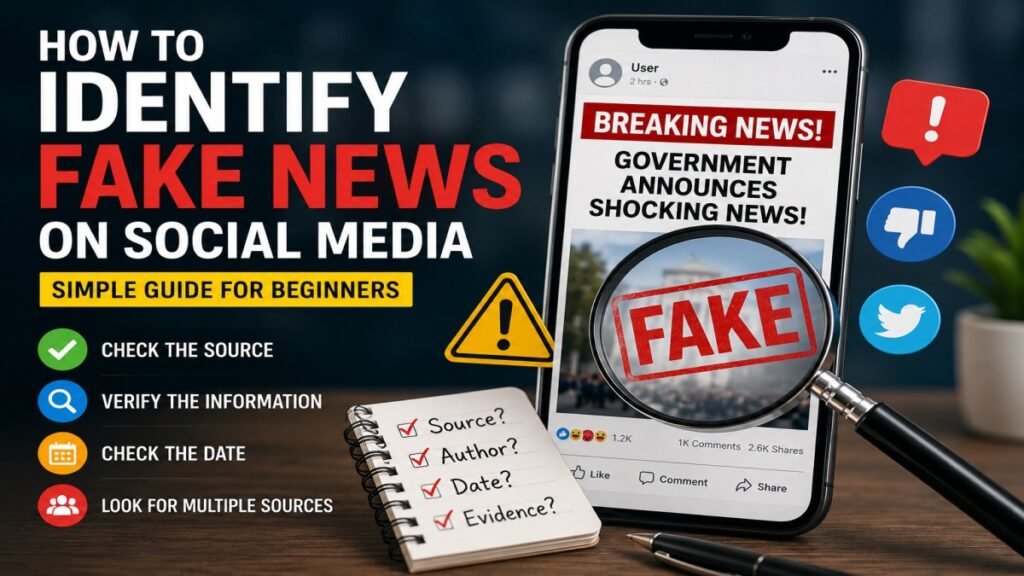
Social media has become a part of our daily life. We read news, watch updates, share videos and often get important information through social media. The problem is that not everything we see online is true. Some fake news looks so real that people believe it without thinking twice and then share it with others. This is why knowing how to spot fake news is a useful online skill. In this guide, we will look at what fake news is, why it spreads so quickly and what you can do before trusting or sharing it.
What Is Fake News?
Every day, thousands of posts, videos and news updates are shared on social media. Most may be genuine, but some contain false or misleading information. This is commonly called fake news. It is not always completely made up. Sometimes an old news story is presented as a new one, a real statement is shown without its full meaning or a claim is made to sound bigger than it really is.
Why Does Fake News Spread So Quickly?
Fake news often tries to create a strong feeling such as fear, anger, surprise or excitement. When people have a strong reaction, they may share a post without thinking about it. For example, a message may say that a popular service will stop working from the next day, or a shocking story about a celebrity may appear in a WhatsApp group. Social media also makes sharing very easy, so one post can reach thousands of people in a short time.
Common Types of Fake News
Fake news can appear in many forms. An old photo may be shared with a new event, making people think the photo is recent. A headline or screenshot may also be changed to give a different meaning. Some posts use fake job notices, government schemes or attractive offers to get attention. Others use made-up claims about celebrities, companies or public events.
Signs That a News Story May Not Be Reliable
Some posts have clear warning signs. Be careful when a message says things like “The media will not show you this” or “Share this with everyone immediately.” Such messages often try to make people react quickly. An unclear source, an unfamiliar website or a headline that sounds extremely shocking can also be a reason to slow down before believing the claim.
How to Verify Information Before Sharing
Before sharing a post that seems important or surprising, check where the information came from and look for the same news on trusted news websites or official websites. Check the date as well, because an old story may be presented as a new one. Reading the full story instead of only the headline can also give you the missing details. If you still cannot confirm the claim, simply do not share it.
Why Can Headlines Be Misleading?
Some headlines are written mainly to get attention and clicks. They may make a story sound bigger or more shocking than it really is. For example, a headline may say, “Famous Company Is Shutting Down.” This may sound like the whole company is closing, while the full story may only say that one service has been stopped.
How Can Images and Videos Be Misleading?
A photo or video does not automatically prove that a claim is true. Old photos can be used with new events, videos can be cut or edited, and AI tools can create realistic-looking images and videos. A visual can therefore give the wrong idea even when it looks completely real.
Common Mistakes People Make
People often share false information without trying to mislead anyone. They may trust a post because it came from a friend, relative or family group. Some also form an opinion after reading only a headline or react immediately to shocking content. These habits can make it easier for false information to spread.
How to Become a More Responsible Social Media User
Being responsible online is not only about protecting yourself from false information. It also means thinking about what you pass on to other people. If a post is doubtful or seems designed to create panic, anger or excitement, there is no need to share it immediately. Taking a moment before passing something on can help prevent unnecessary confusion.
Frequently Asked Questions – Fake News on Social Media
Q1. What is fake news?
Fake news is information that contains false, incomplete or misleading claims and may look like real news. It can appear as a post, message, photo, video or news story.
Q2. Why can fake news be harmful?
Fake news can confuse people and may lead to wrong decisions. False information about health, jobs, money or government services can be especially serious.
Q3. How can I check if a news story is true?
Look at the original source and compare the claim with trusted news websites or official sources. Also check when the information was published and read the full story.
Q4. Can photos and videos also be misleading?
Yes. Photos can come from older events, videos can be edited and AI can create realistic-looking content. A visual alone is not always enough to prove a claim.
Q5. Should I share something if I am not sure it is true?
No. If you cannot confirm the information, it is safer not to share it.
Q6. Is fake news only about politics?
No. Fake news can be about health, education, technology, jobs, celebrities, money, companies and government services. It can appear on almost any topic.
Conclusion
Social media gives us quick access to news and information, but not everything we see online is reliable. Fake news can appear as a headline, message, photo or video and may look completely real.
Learning to notice warning signs and taking a little time before believing or sharing something can help you avoid false information. Being careful about what you pass on also helps reduce its spread to other people.
Related Articles
- Best Free AI Tools for Students in 2026 (Study Smarter, Not Harder)
- AI Hallucination Kya Hai? AI Kab Aur Kyon Galat Jawab Deta Hai? (Complete Guide)
If you are not sure whether a viral claim is true, you can use trusted fact-checking websites to check the information.